Blood Meridian: Part I - The Definitive Audiobook
Spiriti for Judge Holden
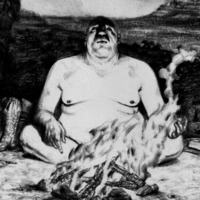

(Sophisticated, educated, playful yet domineering, thick tone of voice with no discernable accent)
Judge Holden, often called 'The Judge', a totally bald albino with the face of an infant, toweringly gigantic, supernaturally strong, demonically violent, Machiavellian, and profoundly learned deputy in the Glanton Gang, second in command to none but John Joel Glanton himself.
In reality, Judge Holden is the true, if not spiritual leader of the Glanton Gang - who constantly preaches to his fellow wretched brigade the theology of violence and war as they traverse the desert landscape. It is implied he carries all languages known to man in his vocabulary, and is ambidexter.
The Judge fell in with the scalp hunters after he helped them to massacre their Apache pursuers with gunpowder he manufactured utilizing little more than bat guano and human urine. He is a studious anthropologist and naturalist, a polyglot, an eloquent lecturer in fields as diverse as biological evolution and jurisprudence. He is an expert fiddler with unusually small hands, a nimble dancer despite his large figure - and has a very dark, twisted sense of humor. Whenever The Judge smiles - there is no place for you to hide.
Holden is also a liar, a sadistic killer, and very possibly a paedophile rapist, and murderer of young children. The Judge has pledged himself absolutely to the god of war, going so far as to claim that war itself "is God."
Fatally severe on those who break partisanship with the god of war, the Judge finds his wayward yet antagonistic spiritual son in 'The Kid', whom he later accuses of poisoning the gang’s enterprise by reserving a measure of mercy in his heart.
Judge Holden is the only member of the Glanton Gang to survive the novel, and through the course of the story almost unintentionally becomes the true protagonist and central focus with his enigmatic, all-absorbing presence. Holden - slowly but surely - infects the narrative like a plague, annihilating everything in his path. Holden came, Holden saw, Holden conquered ...
When The Judge reacquaints with 'The Man' near the end of the horrid tale, he hasn't visibly aged a day. He claims that he will never die, never sleeps - and is "always dancing, dancing."
And lastly - what exactly is Holden a "judge" of? Of violence and war? Of man in Biblical terms - as in "The Judge of all the earth"? Is Holden a wandering, vengeful God roaming carelessly in his own, horrid creation - just for his own amusement and self interest? Is Holden satanic, divine - or just, plain and simply, a man? No clear answer is ever given from McCarthy - which makes his beastly, Melvillian creation all the more fascinating.
In recent times, Judge Holden has been in the conversation as being one of the greatest literary villains penned by an author from the twentieth century - an antagonist worthy of the likes of Lucifer from John Milton's epic poem Paradise Lost, or Mephistopheles from Johann Wolfgang von Goethe's play Faust.
*Recurring appearances*
- male senior
- male adult
1. (Speaking in a theatrical manner to the Christian congregation listening to Reverend Green's sermon) Ladies and gentlemen I feel it my duty to inform you that the man holding this revival is an imposter. He holds no papers of divinity from any institution recognized or improvised. He is altogether devoid of the least qualification to the office he has usurped and has only committed to memory a few passages from the good book for the purpose of lending to his fraudulent sermons some faint flavor of the piety he despises. In truth, the gentleman standing here before you posing as a minister of the Lord is not only totally illiterate but is also wanted by the law in the states of Tennessee, Kentucky, Mississippi, and Arkansas ... On a variety of charges the most recent of which involved a girl of eleven years. Said, eleven! Who had come to him in trust and whom he was surprised in the act of violating while actually clothed in the livery of his God. 2. (Explaining why he maps and collects remnants of his desert surrounding for his ledger) Whatever exists ... Whatever in creation exists without my knowledge exists without my consent.
3. If God meant to interfere in the degeneracy of mankind would he not have done so by now? Wolves cull themselves, man! What other creature could? And is the race of man not more predacious yet? The way of the world is to bloom and to flower and die but in the affairs of men there is no waning and the noon of his expression signals the onset of night… This you see here, these ruins wondered at by tribes of savages, do you not think that this will be again? Aye. And again. With other people, with other sons. 4. It makes no difference what men think of war. War endures. As well ask men what they think of stone. War was always here. Before man was, war waited for him. The ultimate trade awaiting its ultimate practitioner ... That is the way it was and will be. That way and not some other way.
5. Men are born for games. Nothing else. Every child knows that play is nobler than work. He knows too that the worth or merit of a game is not inherent in the game itself but rather in the value of that which is put at hazard. Games of chance require a wager to have meaning at all. Games of sport involve the skill and strength of the opponents and the humiliation of defeat and the pride of victory are in themselves sufficient stake because they inhere in the worth of the principals and define them. But trial of chance or trial of worth all games aspire to the condition of war for here that which is wagered swallows up game, player, all. Suppose two men at cards with nothing to wager save their lives. Who has not heard such a tale? A turn of the card. The whole universe for such a player has labored clanking to this moment which will tell if he is to die at that man’s hand or that man at his. What more certain validation of a man’s worth could there be? This enhancement of the game to its ultimate state admits no argument concerning the notion of fate. The selection of one man over another is a preference absolute and irrevocable and it is a dull man indeed who could reckon so profound a decision without agency or significance either one. In such games as have for their stake the annihilation of the defeated the decisions are quite clear. This man holding this particular arrangement of cards in his hand is thereby removed from existence. This is the nature of war, whose stake is at once the game and the authority and the justification. Seen so, war is the truest form of divination. It is the testing of one’s will and the will of another within that larger will which because it binds them is therefore forced to select. War is the ultimate game because war is at last a forcing of the unity of existence ... War is god.